
Pes planus, more commonly known as flat feet, is a term that has been overly used in the healthcare scenario very often overlooking the complexity of its classification and management. This has led to the widespread prescription of insoles which over the years have undergone technological advancements, often sold at relatively high prices. Research shows that although insoles may help correct the anatomical alterations associated with pes planus, it is a mere short-term solution to the problem. In fact, management of flat feet goes beyond simply correcting the visible differences and must address the biomechanical implications associated with this condition. This raises the question, “Are insoles the gold standard intervention for flat feet, or is at merely a profitable business devoid of genuine understanding?”
Understanding Pes Planus and its Classifications
The first method of classification for the human foot is based on the height of the medial longitudinal arch (MLA) which can be categorised as normal arched, low arched or high arched. The low and high arched are often descriptors of the functionality of an overly pronated or supinated foot respectively. This post will discuss the implications of a low arched foot or simply put; a foot that rolls excessively inwards.
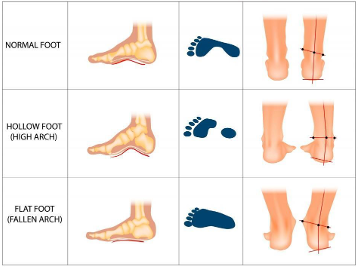
Flat feet can occur in one foot or both, with the most common anatomical feature being an overly pronated and outward facing foot. Additional anatomical differences in the navicular and talar articular surfaces can also be observed which contribute to the collapse of the MLA creating the appearance of a flat foot. Furthermore, if loss of the arch height occurs in both weight bearing and non-weightbearing positions, it is referred to as rigid flat feet. Contrastingly, if collapse only happens during weight bearing and is corrected in a non-weightbearing position, then it is referred to as flexible flat feet. Whilst flat feet may be a congenital feature and most noticeable in children, it can develop later in life most commonly affecting women and people with a high body mass index. In children, flat feet are considered a normal part of growth and development with foot posture typically reaching maturity around ten years of age. Even with this information provided to the parents, most insist on splurging on rigid, supportive footwear and ‘state of the art’ insoles.
Biomechanical Implications of Flat Feet
Human movement is a result of the coordinated and sequential interaction between multiple segments of the body. Research suggests that the anatomical differences resulting from flat feet could influence higher body segments such as the knees, hip and back. It goes without saying, that the feet are not solely responsible for pain causation elsewhere in the lower limb but the possibility of it being an influential factor, cannot be ignored. Mechanical changes that have been observed because of an overly pronated foot include excessive foot abduction, strain on the sole of the foot (plantar fascia), increased rotation of the tibial bone which in turn, places significant mechanical stresses on the knee, femoral torsion and pelvic alignment which could be further associated with low back pain. To the best of this author’s knowledge, no research has quantified the degrees of deviation of these segments from the norm.
Literature has demonstrated that apart from the visual differences exhibited in flat feet, biomechanically they also differ because of these anatomical alterations. Differences in peak forces between muscle groups have been discussed as well as the poor activation of intrinsic muscles of the feet and of the lower leg. Electromyography studies demonstrate that there are poor activation patterns particularly that of the abductor hallucis muscle. This muscle is responsible for movement of the big toe and supporting the arch of the foot during dynamic movement such as running and more evidently in single leg balance. Indeed, individuals with flat feet tend to struggle with generating explosive movement, difficulty in absorbing external impacts and in maintaining balance. Furthermore, collapse of the foot’s arch could affect the angle between the lower leg and the thigh also known as, the ‘Q’ angle causing excessive lateral sheering forces within the knee and tightness in the iliotibial band that runs alongside the outer leg. All in all, this could very much predispose individuals to further risk of injury.
Insoles and their Role in Treatment
Insoles are often the first step to intervention for managing flat feet. They are designed to support foot posture, improve weight distribution and relieve pain not only in the feet but also in other associated areas such as the knees, hips and lumbar spine. Although studies have shown that mechanical changes can be immediate, managing other associated difficulties such as plantar fasciitis, shin splints and patello-femoral knee pain is not as straight-forward. As discussed, providing insoles might help with the immediate changes in structure and gait mechanics however, that will simply mask the symptoms and fail to address the root cause of the problem such as that of muscle weaknesses.
The systematic review conducted by Mendes et al. (2020) has demonstrated that the evaluation and prescription of insoles lacks clear clinical guidelines making it more challenging to achieve long-term benefits. Insoles must be customised and meet the needs of the individual requiring them. Furthermore, the study further established that the different available materials, areas of targeted support and levels of thickness associated with the biomechanical adjustments work differently and target various issues making it even more challenging to provide results. Other authors have also exhibited that management of the mechanical and sensory difficulties associated with flat feet were limited to the ankle and failed to show improvements in the lower limb in its entirety.
Nevertheless, a quick fix, irrespective of the means and cost to get it, very often remains the preferred choice of intervention. People often use expensive items as validation for their hard work in managing a problem and some infamous phrases include, “I paid good money for those insoles, they cannot be the problem, I just need to get used to them.” or “I don’t go anywhere without my insoles, without them I would be miserable!” and “I had these insoles moulded just for me and they cost me a fortune so the pain must be coming from somewhere else!”. This mindset is the reason that businesses continue to target consumers with persuasive marketing and advanced technology to sell their product as the miracle cure for flat feet. Now this is in no way generalising and dismissing all insoles as unnecessary and useless however, why not try simple strengthening exercises to go along with that expensive purchase?
Exercises can help promote strength and facilitate mechanics of the entire lower limb to prevent overloading and further injury. Apart from targeting the muscles of the lower leg typically associated with flat feet, strengthening the surrounding musculature such as the glutes, thigh muscles and calves can improve the overall functional movement and facilitate the distribution of mechanical stress better which in turn, can improve balance and coordination. In addition to this, maintaining flexibility of these affected joints could improve mobility which altogether helps in limiting overuse, preventing fatigue and allows for uninterrupted management of daily activities. Focusing on building foot and lower body strength provides the foundation for an overall resilient body capable of withstanding stresses associated with daily movement and sports.
Summary
The take-home message is that insoles could aid in the management of flat feet but understanding the biomechanical causes and addressing muscle weaknesses could further ensure and promote better foot health. Effectively managing flat feet and lower limb pain requires a comprehensive assessment of the underlying factors and often requires the input of several forms of intervention. By integrating the use of insoles with a simple exercise regime, individuals may benefit from a more sustainable and effective way into ensuring comfort, better function and overall performance.
Rise Physio+ has a skilled team of podologists and physiotherapists who assess foot health and guide clients in finding the right support for their individual needs.
Written by our own Rise Physiotherapist, Nicole Busuttil.
Should you wish to book an appointment with Nicole, book your appointment here: